Listen to this article
Artificial intelligence has fundamentally changed how e-commerce businesses approach marketing. From personalized product recommendations to automated customer service, AI technologies enable online retailers to deliver experiences that were impossible just a few years ago. This guide explores practical ways to leverage AI in your e-commerce marketing strategy and build stronger connections with customers while driving measurable business results.
Why AI Matters for E-commerce Marketing
The e-commerce landscape has become intensely competitive. Customers expect personalized experiences, instant responses, and seamless shopping journeys across all devices. Meeting these expectations manually is nearly impossible at scale. AI provides the intelligence and automation needed to deliver exceptional customer experiences while optimizing marketing spend and operational efficiency.
Research shows that e-commerce businesses using AI-powered marketing see an average increase of 25% in customer engagement and up to 30% improvement in conversion rates. These gains come from AI's ability to analyze vast amounts of customer data, identify patterns, and make real-time decisions that human marketers simply cannot match in speed or precision.
Key AI Applications in E-commerce Marketing
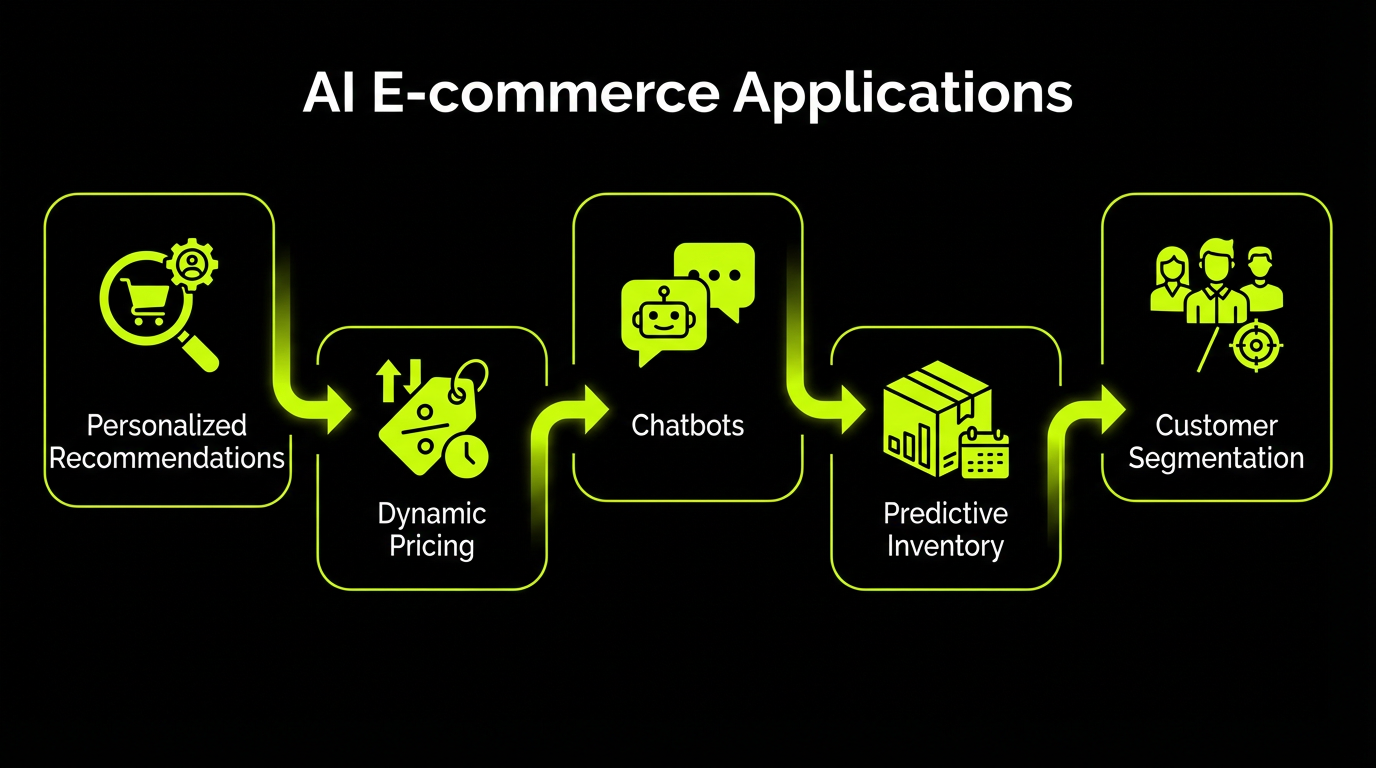
Understanding where AI can make the biggest impact is essential for prioritizing your implementation efforts. The following applications represent the most valuable use cases for e-commerce marketers today.
Personalized Product Recommendations
Product recommendations powered by AI analyze browsing history, purchase patterns, and behavioral signals to suggest items each customer is most likely to buy. Unlike rule-based systems that show generic "bestsellers" or "frequently bought together" items, AI recommendations adapt in real time to individual preferences. This personalization can drive 15-30% of e-commerce revenue when implemented effectively across product pages, shopping carts, email campaigns, and homepage displays.
Dynamic Pricing Optimization
AI enables dynamic pricing strategies that adjust prices based on demand, competition, inventory levels, and customer segments. Rather than setting static prices, AI algorithms continuously analyze market conditions and optimize pricing to maximize revenue and margin. This approach helps e-commerce businesses remain competitive while protecting profitability, particularly important in markets with frequent price changes.
Intelligent Chatbots and Customer Service
AI-powered chatbots handle customer inquiries around the clock, providing instant responses to common questions about orders, shipping, returns, and product information. Modern conversational AI understands natural language and can resolve most routine issues without human intervention. This reduces support costs while improving customer satisfaction through faster response times. When complex issues arise, AI seamlessly escalates to human agents with full conversation context.
Predictive Inventory Management
Marketing effectiveness depends on product availability. AI predicts demand patterns by analyzing historical sales, seasonal trends, promotional calendars, and external factors like weather or economic indicators. This intelligence helps prevent stockouts that frustrate customers and overstocking that ties up capital. Better inventory management directly supports marketing campaigns by ensuring promoted products are available when customers want them.
Customer Segmentation and Targeting
Traditional segmentation relies on basic demographics and broad purchase categories. AI-driven segmentation analyzes hundreds of behavioral signals to create highly specific customer groups based on purchase probability, lifetime value potential, churn risk, and content preferences. These segments enable precision targeting that improves campaign performance and reduces wasted ad spend on unlikely converters.
The AI-Powered Customer Journey
AI transforms every stage of the e-commerce customer journey, from initial discovery through post-purchase engagement. Understanding these touchpoints helps you identify where AI can create the most impact for your business.
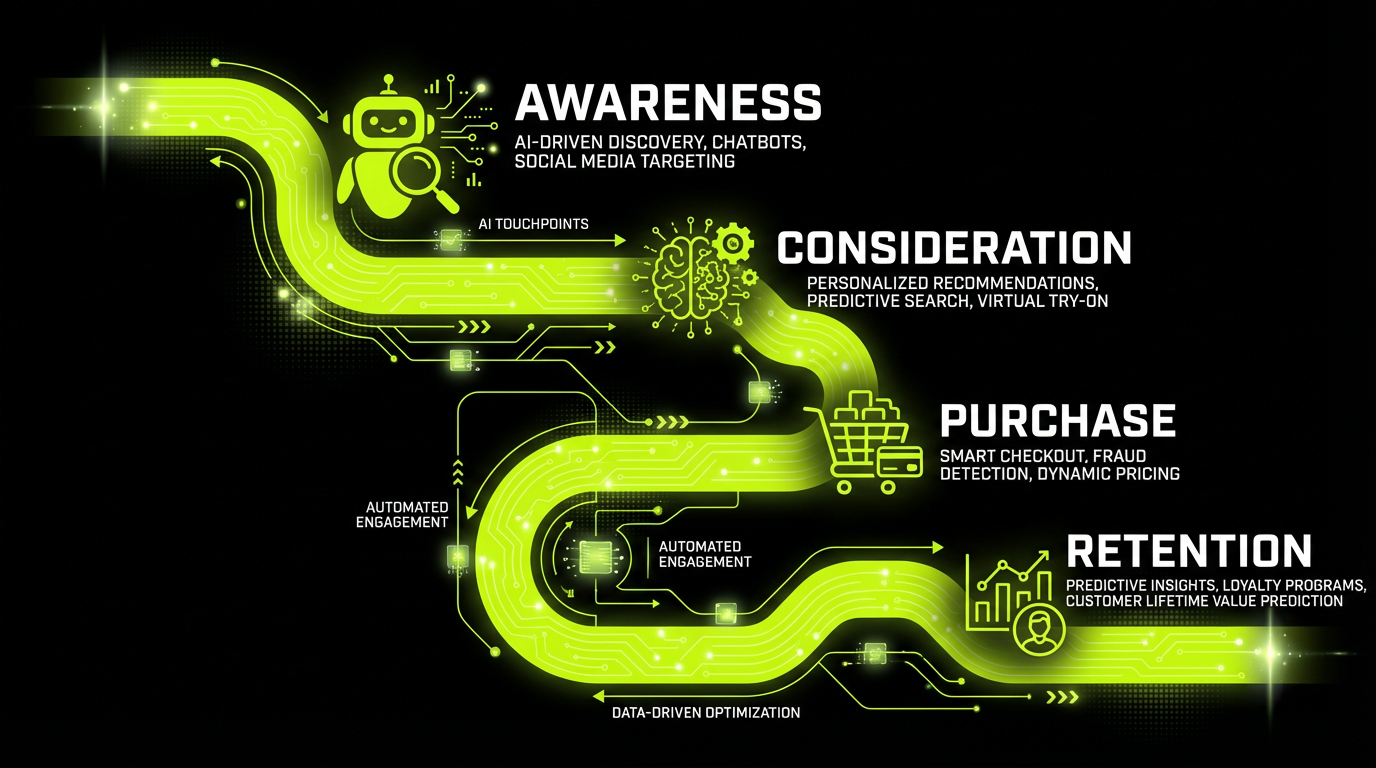
Awareness and Discovery
AI optimizes how potential customers discover your brand. Smart advertising platforms use machine learning to identify high-intent audiences and automatically adjust bidding strategies. AI-powered search engine optimization tools analyze ranking factors and competitor content to recommend improvements. Visual search technology allows customers to find products by uploading images, opening new discovery pathways.
Consideration and Evaluation
During the consideration phase, AI personalizes the shopping experience. Intelligent site search understands natural language queries and surfaces relevant results even when customers use vague or misspelled terms. Product page optimization uses AI to determine which images, descriptions, and social proof elements resonate with different customer segments. Retargeting campaigns leverage AI to determine optimal frequency and messaging for bringing browsers back to complete purchases.
Purchase and Conversion
AI reduces friction at checkout by predicting and preventing abandonment. Machine learning models identify behavioral signals indicating a customer is about to leave and trigger interventions like exit-intent offers or live chat assistance. Fraud detection algorithms protect revenue by identifying suspicious transactions without creating friction for legitimate customers. Payment optimization recommends the most relevant payment methods for each customer based on their profile and location.
Retention and Loyalty
Post-purchase AI applications build long-term customer relationships. Predictive models identify customers at risk of churning and trigger retention campaigns before they disengage. Personalized email sequences deliver relevant content and offers based on purchase history and browsing behavior. AI determines optimal timing and channel for re-engagement messages, maximizing open rates and conversions.
Implementing AI in Your E-commerce Marketing
Successfully implementing AI requires a strategic approach that balances ambition with practical realities. Start with use cases that offer clear ROI and build capabilities incrementally.
Start with Data Foundation
AI is only as good as the data it analyzes. Before implementing advanced AI tools, ensure your data infrastructure captures comprehensive customer interactions across all touchpoints. Unify data from your e-commerce platform, email marketing, advertising campaigns, and customer service systems. Clean, organized data enables AI to generate accurate insights and predictions.
Prioritize High-Impact Use Cases
Focus initial efforts on AI applications with proven track records and measurable impact. Product recommendations, email personalization, and advertising optimization typically deliver quick wins. These foundational capabilities create value while your team develops experience with AI technologies.
Measure and Iterate
Establish clear metrics for each AI implementation. Compare performance against baseline results to quantify impact. AI systems improve over time as they learn from more data, so monitor progress and continuously optimize configurations. Regular A/B testing ensures AI recommendations actually outperform alternatives.
Frequently Asked Questions
How much does AI marketing technology cost for e-commerce businesses?
AI marketing costs vary widely based on business size and chosen solutions. Many platforms offer tiered pricing starting from $50-200 per month for small businesses, scaling to enterprise solutions that cost thousands monthly. The key is measuring ROI—effective AI implementations typically generate returns that far exceed their costs through improved conversion rates and operational efficiency.
Do I need technical expertise to implement AI in my e-commerce marketing?
Modern AI marketing tools are designed for business users, not data scientists. Most platforms integrate with popular e-commerce systems like Shopify, WooCommerce, and BigCommerce through simple apps or plugins. While basic technical comfort helps, you do not need coding skills to leverage AI for product recommendations, email personalization, or advertising optimization.
How long does it take to see results from AI marketing implementation?
Initial results from AI implementations often appear within weeks, though full optimization takes longer. Product recommendation engines typically show measurable conversion improvements within 30 days. Email personalization and advertising optimization may require 60-90 days of learning to reach peak performance. The timeline depends on traffic volume and data quality—more customer interactions provide faster learning.
Getting Started with AI-Powered E-commerce Marketing
The e-commerce businesses that thrive in the coming years will be those that effectively harness AI to understand customers, personalize experiences, and optimize marketing investments. Whether you are just beginning to explore AI capabilities or looking to expand existing implementations, the key is taking action. Start with one high-impact use case, measure results carefully, and build from there.
BlackWhite Marketing's AI-powered platform helps e-commerce businesses develop comprehensive marketing strategies tailored to their unique products, customers, and goals. Our questionnaire-based approach captures the essential details about your business, and our AI generates actionable marketing plans you can implement immediately.